The 5 Best Poke Alternatives in 2026

Short answer: the right Poke alternative depends entirely on why you're leaving, and the reasons people actually leave are pretty distinct.
- You don't love that a startup holds your inbox → OpenClaw, self-hosted
- It notifies you well but forgets what you told it → Saner.ai
- You wanted accountability, not logistics → Tomo
- You'd rather talk than type → Martin
- You want it to finish the errand, not just flag it → Muse
First, what actually happened to Poke
Poke's maker, The Interaction Company of California, was acquired by Cognition (the company behind the Devin coding agent) on July 23, 2026, in a deal reported in the low nine figures. Poke keeps operating, and pricing hasn't changed so far.
The reasons people actually leave Poke
I went looking for complaints rather than praise, because the praise is easy to find and less useful.
- The negotiated pricing. Poke has no fixed tiers. You haggle with a bot at signup and land somewhere around $10 to $30 a month. Reports of people talking it down from opening offers of $292 are real.
- Reliability at the edges. Not everyone gets the smooth version. At least one user wrote a one-star review after weeks of use saying basic email checks took fifteen minutes or more when they worked at all.
- It notifies better than it remembers. This is the sharpest criticism and the most interesting one. A text thread is a superb notification channel and a terrible filing cabinet. Poke is strong at the last mile (telling you a thing) and weaker at holding onto what you decided last Tuesday.
- It won't email people outside your contacts. Poke is a consumer assistant for your own life. It texts you. It won't run a client-facing workflow, which surprises people who try to use it for work.
Quick alternative comparison
| Alternative | Fixes which problem | Where it lives | Price | Free tier |
|---|---|---|---|---|
| Saner.ai | Memory, and clear pricing | Web, mobile, Chrome | $8 or $16/mo | Yes |
| Tomo | Follow-through, not logistics | SMS | Paid, free tier | Yes |
| OpenClaw | Data control | Your own machine, any chat app | Free, you pay model costs | Open source |
| Martin | You'd rather speak | Phone call, SMS, WhatsApp, Slack, iOS | Paid after 7-day trial | No |
| Muse (Meta) | Executing, not just flagging | Muse app, WhatsApp, muse.ai | $20 or $100/mo | Yes |
1. Saner.ai
Switch here if: your complaint is that Poke tells you things well but doesn't hold onto them.
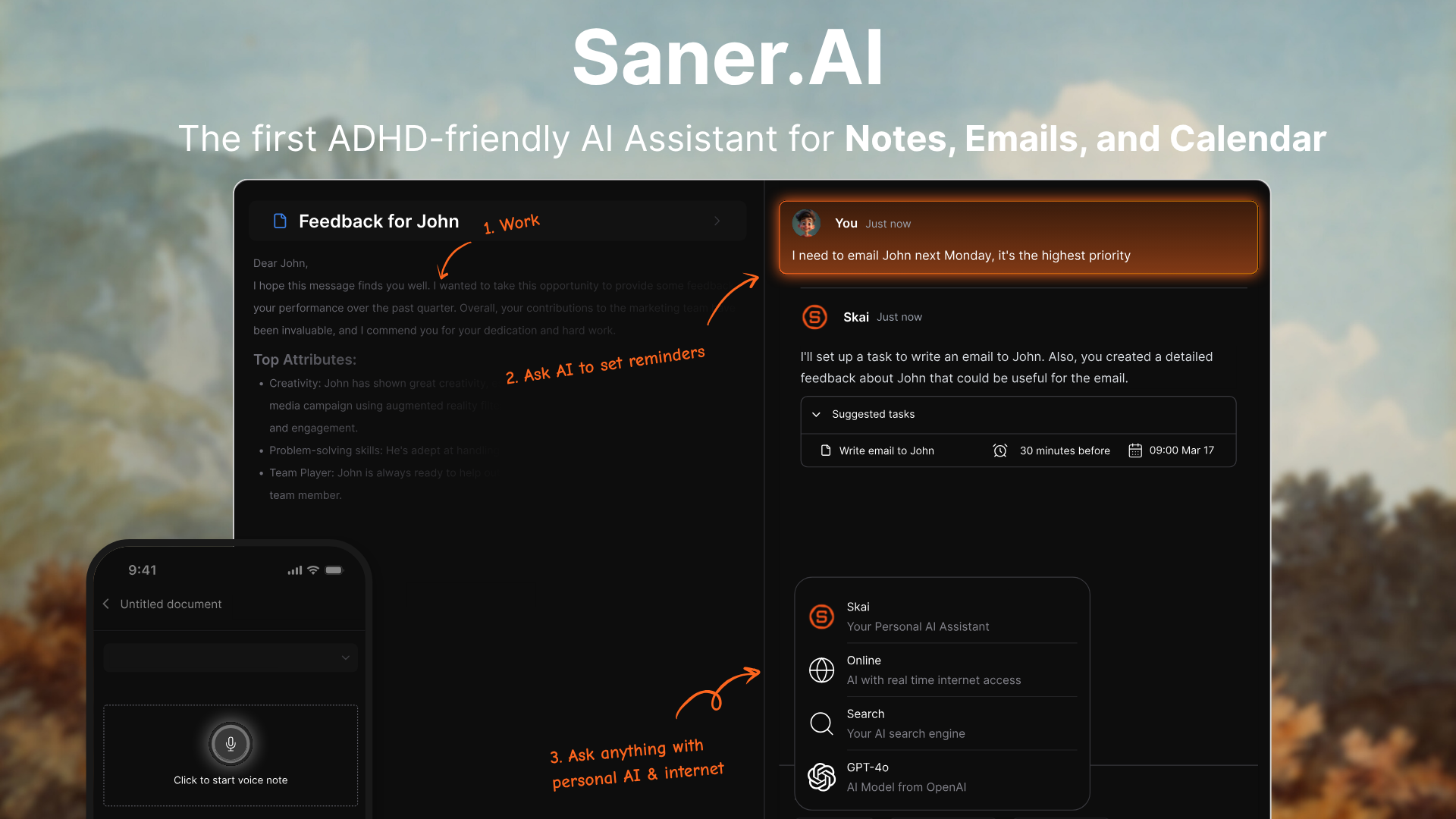
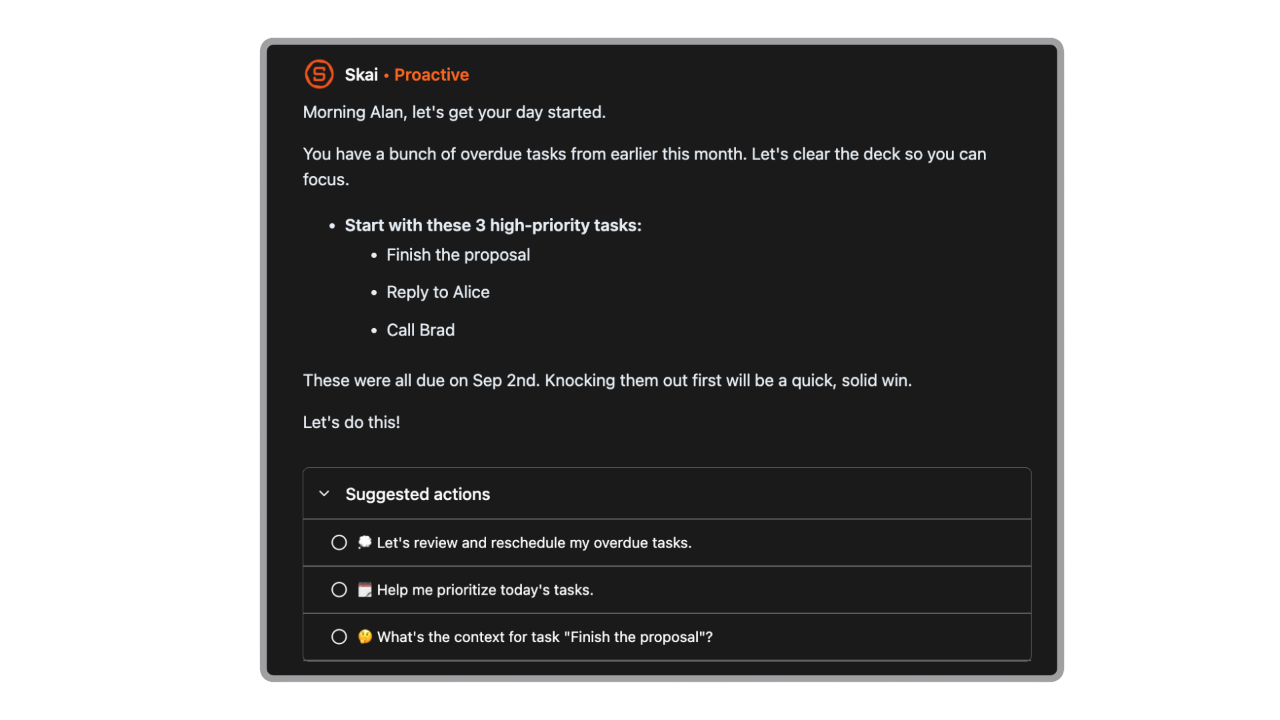
Saner is a workspace rather than a text thread. Notes, tasks, email and calendar in one place, with an assistant called Skai that captures across all of it and gives you a proactive morning plan. The structural difference from Poke is that there's somewhere for information to live. Poke's memory is a conversation. Saner's is a knowledge base.
- It plans your day proactively, search your notes, triage your emails. Think a better professional alternative for Poke
- Free plan: 30 AI messages a month, 100 notes, 100MB storage.
- Starter $8/month, Standard $16/month on annual billing. Numbers printed on a page, no negotiation, no bouncer.
- Built by a team including a co-founder with ADHD, which is where the product came from rather than a marketing angle.
Try this today: take the three things you've told Poke this week that it's since lost track of. Put them in Saner as a braindump, unsorted, and see what the morning plan does with them tomorrow.
Weakness: you lose the thing Poke is best at. There's no "it texts me in iMessage and I never open an app." Saner is a place you go. It's also young.
2. Tomo
Switch here if: you realised you didn't want a secretary. You wanted someone to make you do the thing.
Tomo runs over SMS with no app to install. Where Poke manages your logistics, Tomo works on you: goals, habits, follow-through. It checks in later about the thing you said you'd do.
- Runs over plain text messages.
- Integrates with Notion, Google Drive, Gmail and Google Calendar.
- Free tier plus paid.
Try this today: name one thing you've been avoiding for over two weeks, tell Tomo, and explicitly give it permission to be annoying about it.
Weakness: the review pool is small and it isn't all positive. At least one Trustpilot reviewer flatly called it a scam!? And if you're leaving Poke partly because unsolicited texts stress you out, Tomo is a lateral move at best. It texts more, not less.
3. OpenClaw
Switch here if: the privacy thing is your actual objection, and you're technical enough to act on it.
OpenClaw is an open-source personal agent from PSPDFKit founder Peter Steinberger. It runs as a local gateway on your own machine, connecting AI models to your files and apps, and reaching you through Discord, iMessage, Signal, Slack, Telegram or WhatsApp. Around half a million systems are running it. Steinberger has since joined OpenAI.
This is the only real answer to "I don't want a company holding my inbox," because with OpenClaw, no company does. You do.
Read this before you install anything. The standard advice for non-technical users is: don't put it on your personal computer, don't connect accounts you'd be devastated to lose, and start read-only. Prompt injection is a live risk, because hostile instructions can hide in emails and web pages the agent reads. One developer running it as a personal assistant created a separate, isolated Gmail account so the only mail it ever sees is what he forwards to it.
Try this today: if you're comfortable in a terminal, install it, connect Telegram only, give it a scratch folder and nothing else, and see if you still like it in a week. If you're not comfortable in a terminal, this is not your alternative and that's fine.
Weakness: you have swapped "a startup might mishandle my data" for "I might mishandle my data." That's a real trade, not a free win. It also costs you model fees and a weekend.
4. Martin
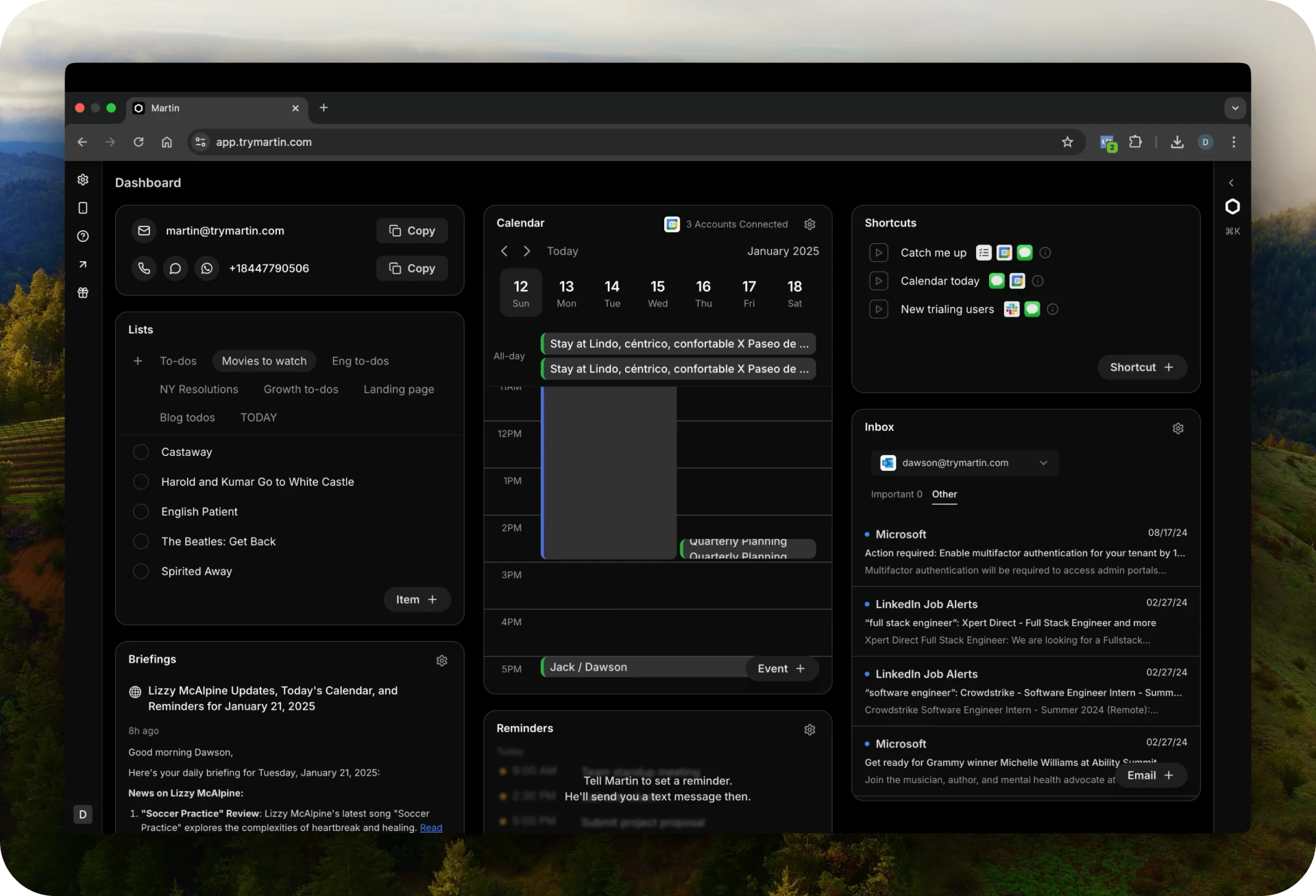
Switch here if: typing to an assistant never felt natural and you'd rather just say it out loud.
Martin is voice-first, which almost nothing else in this category is. You reach it by actual phone call, plus SMS, WhatsApp, Slack and email. It connects to Gmail and your calendars, drafts and sends replies, schedules, sets reminders and wake-up calls, and can make calls or send texts for you.
- Seven-day free trial, then a paid subscription, cheaper billed annually.
- Keeps inbox, calendar and history in working memory so you can ask it to act across all three.
Try this today: call it while you're driving or walking and ask it to move your afternoon. That's the use case.
Weakness: the public review footprint is thin, and one directory lists it at 1 out of 5 from a single verified review, which tells you approximately nothing except that there isn't much data. Also, this is the key weakness: the founders STOPPED developing the business.
5. Muse
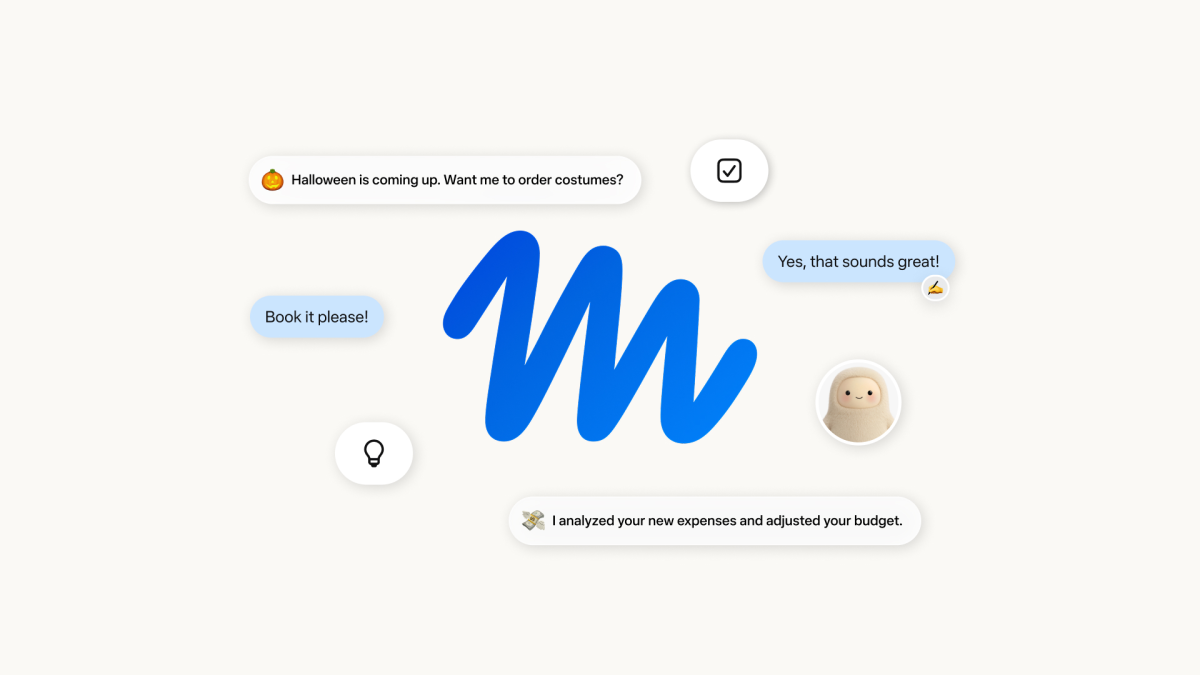
Switch here if: your complaint is that Poke tells you about the thing instead of doing the thing.
Muse is Meta's personal agent, launched September 8, 2026, US only, 18 and over. You give it a goal and it opens a browser, fills forms, sends the email and pays the bill inside your own connected accounts. It runs on a dedicated virtual machine with a separate agent called Sentinel that has to approve anything leaving for the internet.
- Free tier with weekly limits, Power at $20/month, Maximum at $100/month. The paid tiers buy usage, not features.
- Reachable in its own iOS and Android app, on the web at muse.ai, or through WhatsApp.
The obvious problem. If you're leaving Poke over privacy, Muse is a strange destination 🤣 It wants email, calendar, payments and health services, from a company with, let's say, a complicated history on this exact subject. I'm not going to talk you into or out of that. You already have a view.
Try this today: one low-stakes errand with no payment attached, and watch the browser window while it works. That visibility is the part worth evaluating.
How to switch without making a mess
- Revoke access before you cancel. Go to your Google or Microsoft account security settings and remove the old assistant's access directly. Cancelling a subscription does not always revoke an OAuth grant, and an orphaned token with inbox access is exactly the thing you were worried about.
- Export anything it's holding. Recipes, routines, saved preferences. Most of it is reconstructable, but not if you cancel first.
- Keep your calendar and email where they were. Google or Outlook stays the source of truth. The assistant is a layer, and layers get acquired.
- Set quiet hours on day one of the new tool. See the section above. This is the single highest-value five minutes you'll spend.
- Give the new one one job for two weeks. Not "manage my life." One job, so you can tell whether it's actually better or just new.
When you should just stay on Poke
I'd be a bad reviewer if I didn't say this part.
- If the messaging-first thing is why you liked it, nothing else on this list matches it. Poke was one of the first AI agents reachable through iMessage and became the first approved for Apple's Messages for Business in June 2026. That's not marketing, it's distribution nobody else has.
- If your complaint is the price, try renegotiating rather than churning. The pricing is conversational by design, which cuts both ways.
- If your complaint is the acquisition, wait and watch. Cognition says users continue as before and pricing is unchanged. Switching costs are real and speculation isn't a reason to pay them.
Switch when the problem is structural, which means memory, privacy, channel, or what it's actually for. Don't switch because a listicle told you to. Including this one.
FAQ
Is Poke shutting down? No. The Interaction Company was acquired by Cognition on July 23, 2026, but Poke continues to operate and pricing is unchanged so far. Users were told they can continue as before.
What's the best free Poke alternative? Saner.ai has a genuine free plan. Tomo and Muse have free tiers. OpenClaw is free and open source, though you pay for the AI model behind it and it requires technical setup.
Which Poke alternative is best for privacy? OpenClaw, because it's self-hosted and your data stays on your own machine. Worth knowing that self-hosting shifts responsibility to you: prompt injection is a real risk, and the standard advice is to start read-only with an isolated email account rather than connecting your main inbox.
Why does Poke's pricing change per person? Poke uses negotiated pricing rather than fixed tiers. You settle a monthly price by chatting with the assistant at signup, and people typically land between $10 and $30 a month. Reported opening offers have been far higher, so the first number isn't the real one.
Can any of these email people outside my contacts? Poke generally won't, which is a known limitation for anyone trying to use it for work. If you need an assistant that runs outward-facing workflows, you're looking at a work-oriented AI executive assistant rather than a personal one, which is a different category from everything on this page.
Is Saner.ai better than Poke? Different. Saner gives you persistent memory, a decent workspace and printed pricing; Poke gives you a proactive assistant in the messaging app you already use. If your problem is that Poke forgets, Saner helps. If your problem is that you won't open another app, it doesn't.